Turn Food Waste into Energy and Fertiliser
Modular anaerobic digestion systems for communities, schools, and eco-lodges.
Discuss a System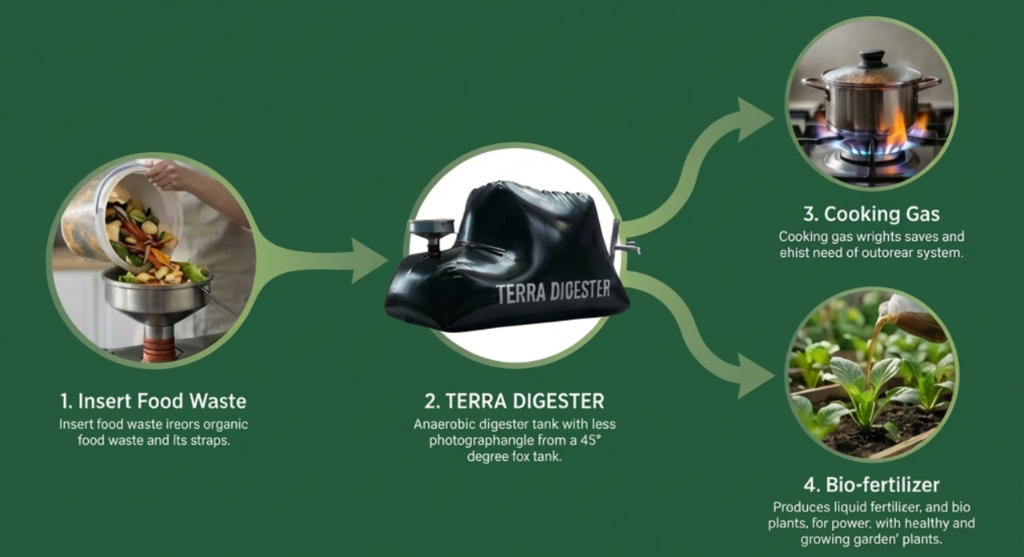
How Our Terra Digester
Systems Work
Four stages — from organic waste input to clean cooking gas and bio-fertiliser.
Insert Organic Waste
Organic waste — food scraps, vegetable peels, fruit leftovers, kitchen residues — is fed into the Terra Digester via the stainless-steel inlet sink. No pre-treatment or sorting is required.
Anaerobic Digestion Process
Inside the sealed flexible membrane, anaerobic microorganisms break down organic matter in a completely oxygen-free environment. The biochemical process — running at 35–40°C — produces methane-rich biogas naturally.
Clean Cooking Gas Generated Daily
The biogas produced — containing approximately 60–70% methane — travels via a flexible pipe to your cooking burner or gas appliance. The system generates a renewable, clean-burning fuel every day, directly from your organic waste.
Liquid Bio-fertiliser Output
Alongside biogas, the anaerobic digestion process produces a nutrient-rich liquid digestate — a natural bio-fertiliser containing nitrogen, phosphorus, and potassium. It flows out via the outlet tap and can be applied directly to soil, gardens, and farmland.
Designed for Multiple Contexts
From individual households to institutional kitchens — our systems are configured to fit the context.
Backyards & Households
Compact units designed for household-scale organic waste processing. Suitable for families seeking to reduce kitchen waste and produce their own cooking gas and garden fertiliser.
Schools & Institutions
Medium-capacity systems suitable for school canteens and institutional kitchens, converting significant daily food waste volumes into measurable energy and fertiliser outputs.
Eco-lodges & Sustainable Centres
Off-grid capable systems for sustainable tourism and community centres, supporting circular waste management as part of a broader environmental commitment.
What the System Delivers
Landfill Diversion
Reduce organic waste sent to landfill, directly lowering methane emissions from anaerobic decomposition in open sites.
Clean Cooking Gas
Generate clean biogas suitable for cooking and heating, reducing dependence on purchased LPG or firewood.
Organic Fertiliser
Produce nutrient-dense digestate suitable as organic fertiliser, supporting soil health and reducing need for chemical inputs.
Emissions Reduction
Capture methane that would otherwise be released through open decomposition, converting it into useful energy instead.
Reduced Waste Costs
Lower operational waste management costs by converting waste streams from a cost centre into an on-site energy resource.
Nutrient Cycles
Support local food-soil nutrient cycles — returning organic matter to the soil that produced it, closing the biological loop.
Engineering Principles
Our systems are developed around four core design commitments.
Modular Architecture
Each system is a self-contained module — scalable, replaceable, and adaptable to changing capacity needs.
Low-Maintenance Design
Engineered with minimal moving parts, reducing maintenance complexity and extending operational life in the field.
Off-Grid Capable
Designed to operate without connection to grid utilities — suitable for remote, rural, and off-grid applications.
Weather-Resistant
Constructed with materials selected for durability across variable climates, temperature ranges, and environmental conditions.
Common Questions
Everything you need to know before getting started.
Organic waste enters through the inlet, and anaerobic bacteria inside the sealed bag break it down over 15–30 days. Methane-rich biogas rises to the top for cooking; liquid bio-fertiliser flows from the outlet tap. No electricity, no chemicals — just natural biology.
Food scraps, vegetable peelings, fruit waste, cooked leftovers, and small amounts of animal manure all work well. Avoid large quantities of oils or meat. The more consistent the daily input, the more stable the gas output.
The bacterial colony needs 2–3 weeks to establish after the initial loading. Once active, the system produces biogas continuously. Daily feeding equals daily cooking gas — and the system can handle gaps; you do not need to feed every single day.
No. The sealed, oxygen-free environment is what makes anaerobic digestion work — and what eliminates odour. There is no smell during normal operation. Any odour would indicate a seal issue, which is straightforward to diagnose and resolve.
Outdoors in a sunny, sheltered spot is ideal — near a water source for easy feeding. It can also be placed inside a well-ventilated greenhouse. Choose a flat, stable surface. Biogas pipe runs of up to 50 m are possible with good pressure.
Dilute at roughly 1:3 (fertiliser to water) before applying. It is richer than raw compost — packed with nitrogen, phosphorus, potassium, amino acids, and beneficial microorganisms that are immediately bioavailable to plants.
Best performance above 18 °C (64 °F). Below 10 °C, activity slows significantly. In colder climates, insulate the bag or site it in a greenhouse. Reduce feeding by half in winter; avoid feeding if the system is frozen.
No emptying needed — liquid digestate flows out continuously as you add waste. The interior does not require cleaning. Replace the gas filter every 6–12 months. The system exterior can be cleaned with water only. Expected lifespan is over 15 years.
Yes — and we recommend using a stove designed for low-pressure biogas. The gas is uncompressed, so standard LPG appliances require a simple adaptor. The system produces enough gas for 1–3 hours of daily cooking depending on input volume.
Yes. Biogas is stored at very low pressure, uncompressed. Being lighter than air, any leak disperses upward safely rather than pooling at ground level. The sealed design prevents open-flame risk at the bag itself. The system meets international biogas safety standards.
Discuss a Food Waste System
Whether you are planning a household installation or a community-scale system, we are ready to explore the right configuration with you.
Start a Conversation