Sanitation Without Infrastructure
Engineered biological sanitation for off-grid communities, eco-tourism, and temporary installations — only 1.2 L per flush, no sewage network, no mains water required.
Enquire About Bio-toilets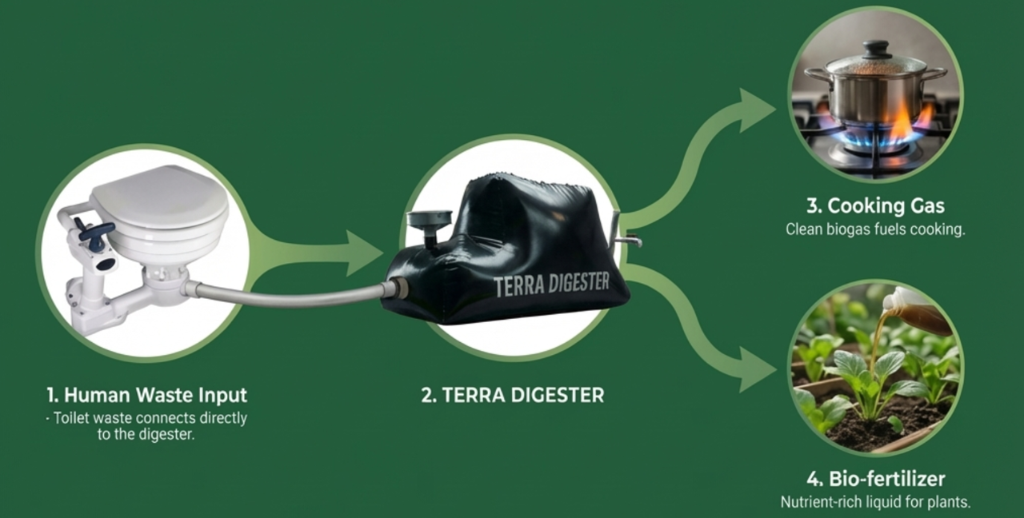
A Global Sanitation Gap
Conventional sewage systems demand substantial water consumption and extensive infrastructure investment — resources that remain unavailable for billions of people and countless temporary or remote locations.
- According to WHO data, approximately 3.6 billion people lack access to safely managed sanitation.
- Conventional flush toilets require between 6 and 13 litres of potable water per use — a significant burden in water-scarce contexts.
- Temporary events, construction sites, nature reserves, and emergency response situations require sanitation solutions that can be deployed without fixed infrastructure.
- Open defaecation and poorly managed waste present serious public health and environmental risks in underserved areas.
From Waste to Clean Energy
Four steps. One sealed system. Just 1.2 L per flush — no sewage network, no mains supply. Daily biogas and bio-fertiliser output.
Four steps. One sealed system. Daily output of energy & fertiliser.
Waste Input
Ultra-low flush: only 1.2 L. No mains supply needed. Off-grid ready.
Anaerobic Digestion
Sealed chamber. 15–30 day retention. Bacteria convert waste to biogas.
Cooking Gas
Methane-rich biogas piped to stove. Smoke-free. Replaces LPG.
Bio-fertiliser
Liquid digestate flows daily. N·P·K rich. Free organic fertiliser.
Human Waste Directly Connected
The bio-toilet connects to the Terra Digester via a sealed pipe. Each flush uses just 1.2 L — no mains water or sewage network required. Water can come from a bucket, basin, or recycled greywater (e.g. washing water). A foot pump or hand pump generates the pressure. No electricity needed.
Anaerobic Digestion Breaks It Down
Inside the sealed Terra Digester bladder, naturally-occurring anaerobic bacteria decompose the human waste in a completely oxygen-free environment. Over a 15–30 day retention period, microorganisms convert organic matter into methane-rich biogas (CH₄) that rises to the top, and nutrient-rich digestate that settles below. Pathogens are significantly reduced during this process.
Clean Cooking Gas
Methane-rich biogas rises to the top of the sealed Terra Digester bladder and is piped directly to a kitchen stove through a simple gas line. It burns with a clean blue flame — completely smoke-free and odourless, replacing expensive LPG cylinders or harmful firewood. A single bio-toilet system can generate meaningful daily cooking fuel for a household or small community.
Nutrient-Rich Bio-fertiliser
As the digestion cycle completes, liquid digestate flows from the outlet tap — a nutrient-rich bio-fertiliser containing nitrogen, phosphorus, and potassium. Applied directly to garden beds, fields, or trees, this completely free daily output replaces expensive chemical fertilisers and closes the organic cycle. Nothing is wasted; everything becomes a resource.
Designed For
Three primary contexts where conventional sanitation fails — and where bio-toilet systems are engineered to perform.
Remote & Rural Communities
Communities in peri-urban fringes, rural areas, and regions without municipal sewage infrastructure can access safe, dignified sanitation without waiting for grid connection. Systems are configured for community-scale deployment with multiple units.
Eco-tourism & Nature Reserves
Sustainable tourism sites — game reserves, wilderness lodges, national parks, and coastal eco-resorts — benefit from sanitation that does not compromise their environmental credentials or disturb natural ecosystems with infrastructure.
Temporary & Mobile Installations
Construction sites, outdoor festivals, humanitarian response camps, and temporary event venues require sanitation that can be deployed quickly, operated without infrastructure, and relocated as needs change.
Designed to Reduce Environmental Burden
Our systems are engineered to deliver meaningful environmental outcomes across three key dimensions.
Water Conservation
Each unit is designed to eliminate flush-water consumption entirely. In water-scarce regions or areas with water access challenges, this represents a significant operational and resource benefit.
Methane Capture
By capturing methane generated during anaerobic digestion, our systems prevent direct atmospheric release — converting a potent greenhouse gas into a contained, potentially usable energy source.
Pathogen Management
Anaerobic digestion, when operated over an adequate retention period, is designed to achieve significant reductions in pathogen load — reducing public health risks associated with open waste exposure.
Note: Performance outcomes are described using "designed to achieve" language. Actual results depend on installation context, usage patterns, and maintenance. Detailed performance data available upon request.
Common Questions
Everything you need to know about the Terra Digester bio-toilet system.
The bio-toilet uses just 1.2 L per flush — about 1/6th of a conventional toilet — to carry waste through a sealed pipe into the Terra Digester. Anaerobic bacteria break the waste down over 15–30 days, producing biogas for cooking and liquid digestate for the soil. No sewage connection or mains water needed.
No. The system is fully self-contained — no municipal sewage, septic tank, or drainage infrastructure required. This makes it ideal for off-grid sites, eco-tourism lodges, remote communities, and humanitarian camps.
No. The sealed, oxygen-free environment eliminates odour entirely. Unlike composting toilets, there is no smell during normal operation — making it comfortable for indoor or semi-indoor use. Any odour is a clear sign of a seal issue, which is easy to resolve.
Just 1.2 litres per flush — roughly 1/6th of a standard toilet's 6–13 L. No mains or pressurised water supply is needed: a bucket, basin, or recycled greywater works perfectly. A foot pump or hand pump generates the flush pressure. No electricity required.
Yes. The toilet unit can be placed indoors as long as the pipe run to the outdoor digester is within roughly 5 m on the same level, or up to 10 m if the toilet is elevated 1 m above the digester. A short ventilation stack (90 mm, max 2 m) removes any residual air.
Avoid large amounts — they slow digestion and can block the inlet. Thin, unbleached paper in small quantities is generally fine. We recommend reviewing your specific setup with us to find the best inlet configuration.
Use only water, vinegar, or eco-certified biological cleaners. Bleach, antibacterial sprays, and chemical disinfectants kill the anaerobic bacteria and stop the process. Keep cleaning simple and natural.
Digestate flows continuously to a mulch basin, drain field, or is managed per local regulations. It supports soil health and reduces pathogens significantly through anaerobic digestion. Do not apply directly to edible plants without further treatment or local guidance.
The system functions from around 5 °C (41 °F), though biogas production is best above 21 °C (70 °F). Avoid hard freezes. In colder regions, insulating the digester bag and siting it in a sheltered spot keeps performance stable year-round.
Yes. Biogas is stored at very low pressure, uncompressed — if any leak occurs, it rises and disperses safely upward. The system design meets international biogas safety standards. All installations are completed with a commissioning check to ensure seals and connections are fully secure.
Discuss a Bio-toilet Solution
Whether for a remote community, an eco-tourism site, or a temporary installation — we can help design the right sanitation approach.
Start a Conversation